
Understand the decision
The single biggest driver of stock accuracy isn't a software feature list, it's whether your team scans. Manual counts and re-keying introduce error at every step; barcode and RF scanning capture each movement at the point it happens, so the system matches the shelf.
This guide covers how scanning works in practice for NZ operators, receiving, putaway, picking, dispatch and cycle counts, what hardware fits, and where scanning sits in the inventory-vs-WMS spectrum.
OpsUI's warehouse modules run scanner-driven workflows on standard devices; here's honestly when you need that depth and when a basic inventory tool is enough.
Requirements and options.
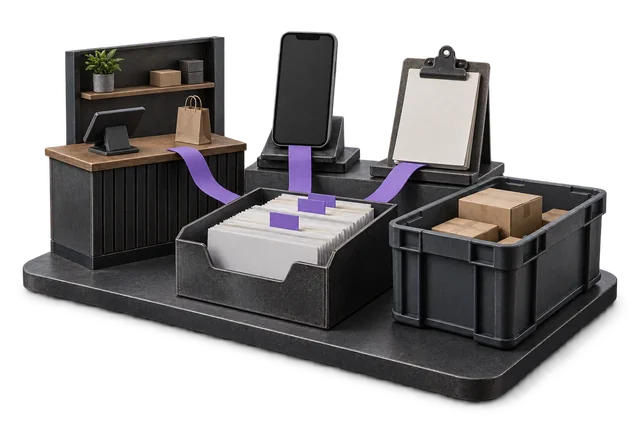
Scan at receiving
- OpsUI context
- ASN/PO receiving by scan, with discrepancy capture
- Wider options and considerations
- Often manual entry
Vendor-specific detail: confirm current scope and evidence.
Scan picking
- OpsUI context
- Scanner-guided picking and pack verification
- Wider options and considerations
- Paper/manual, or a higher tier
Vendor-specific detail: confirm current scope and evidence.
Cycle counts by scan
- OpsUI context
- Rolling counts on mobile, with variance investigation
- Wider options and considerations
- Periodic manual stocktakes
Vendor-specific detail: confirm current scope and evidence.
Hardware
- OpsUI context
- Standard Android/iOS devices plus ring/handheld scanners (see hardware)
- Wider options and considerations
- Varies; sometimes proprietary
Vendor-specific detail: confirm current scope and evidence.
Stock record
- OpsUI context
- Bin-level, real-time, synced to the ledger
- Wider options and considerations
- Location/pool-level
Vendor-specific detail: confirm current scope and evidence.
Pricing
- OpsUI context
- Confirm current subscription, allowances and implementation costs against an itemised proposal; the commercial structure is explained below.
- Wider options and considerations
- Often per-user or an add-on
Vendor-specific detail: confirm current scope and evidence.
Local operating considerations
OpsUI runs barcode/RF scanning across its warehouse modules (Receiving, Picking, Cycle Counting, Shipping) on standard Android/iOS devices and dedicated scanners, see hardware for the device side. Confirm current subscription, allowances and implementation costs against an itemised proposal; the commercial structure is explained below. For where scanning sits between inventory and WMS, see wms vs inventory management and inventory management software nz.
Ask which carrier accounts, services and label formats are supported; how your accounting records move; and where production data, backups and logs are held. Record the answers for the exact deployment under consideration.
Compare the full operating cost.
Separate subscription cost from user allowances, integrations, devices, data preparation and onboarding. Ask who owns configuration, training, cutover and support, and which items are recurring.
A starting subscription price is not an implementation quote. Compare the same workflows, team size and transaction volumes across proposals. Keep the original currency, tax treatment and billing period visible.
OpsUI’s published package structure
Essential
NZ$499per month
2 users included
2 operational modules
Control
NZ$1,499per month
5 users included
5 operational modules
Command
NZ$2,999per month
15 users included
11 operational modules
Apex
NZ$11,990per month
Unlimited users
20 operational modules
Published monthly subscriptions in NZD. Existing annual pricing and package allowances apply. Additional seats are NZ$99 per month beyond the applicable allowance; integration connectors are separate add-ons.
Review the full packages and configure pricing →A checklist you can use in a demonstration.
Bring representative records and ask each vendor to work through the same scenarios. Write down what was demonstrated, what needs configuration and what remains unverified.
- Receive a discrepancy. Use an expected delivery with a missing line and damaged stock. Follow the difference through recording, review and the stock decision.
- Allocate constrained stock. Use two orders competing for the same stock. Check reservations, priorities and what the service team sees.
- Resolve a short pick. Start with an empty pick location. Show the exception, reassignment or backorder, and who can approve the next step.
- Complete the dispatch handoff. Use your carrier, parcel mix and label format. Check tracking references, manifests and a rejected address.
- Recover from an interrupted sync. Reject a record or interrupt delivery. Show visibility, retry behaviour, duplicate prevention and reconciliation.
- Confirm access and reporting. Run the same scenario as an operator and supervisor. Check action permissions and the records available for investigation.
Fit and trade-offs
When you don't need scanning yet
If you sell a tiny single-location catalogue at low volume, a periodic manual stocktake may keep you accurate enough without any scanning workflow.
If you don't have bin locations or a real pick face, scanning adds little, the value comes from capturing movements you currently re-key.
If your need is purely accounting-inventory, Xero or MYOB's native tracking may suffice until volume or locations grow.
When scanner-driven accuracy pays off
Once you're multi-location, picking from bins, or moving real order volume, scanning eliminates the error and re-keying that periodic counts can't — receiving, putaway, picking, dispatch and cycle counts all captured at the point of action.
Flat per-module pricing lets you put scanners in front of every floor worker without a per-user tax, so accuracy isn't rationed by licence cost.
Every scan reconciles back to the stock record and the ledger (Xero, MYOB or NetSuite), with NZ data residency, so floor accuracy and the books stay in step.
Questions buyers ask.
Do I need barcode scanning for inventory?
If you're multi-location, pick from bins, or move real order volume, yes, scanning is the difference between a stock record that matches the shelf and one that drifts between manual counts. If you sell a tiny single-location catalogue at low volume, periodic stocktakes may be enough for now.
What hardware do I need for barcode scanning?
OpsUI's scanning runs on standard Android and iOS devices as well as dedicated ring and handheld scanners, so you don't need a proprietary fleet, a phone with the right scanner attachment works for smaller operations, and rugged devices for high-volume floors. See hardware for the options.
Does barcode scanning work with Xero or MYOB?
Yes — OpsUI captures movements by scan and syncs the resulting stock valuations and adjustments back to Xero, MYOB or NetSuite (NetSuite live today; Xero/MYOB wired during rollout), so floor accuracy reconciles with the ledger automatically rather than being re-keyed.
Are barcode cycle counts better than an annual stocktake?
For most growing operations, yes, rolling cycle counts on a scanner maintain accuracy continuously and surface variances early, without the disruption (and the year-old error) of a single annual shutdown count. OpsUI's Cycle Counting module is built around that workflow.
How much does barcode inventory scanning cost?
Compare the required modules, users, order allowances, integration work and implementation responsibilities before comparing prices. OpsUI’s current package structure is shown on this page. Current competitor prices and terms need confirmation with the vendor; historical estimates are not a current quote.
Sources and evidence
Checked facts apply only to the scope described next to each source. Other vendor details in the editorial analysis remain unverified for a current purchase decision. Confirm them with the vendor and record the applicable plan, version and proposal date.
Current primary-source verification of this vendor’s detailed capabilities and prices is pending. An unknown is not a missing feature.
OpsUI integration delivery and scope · Security review information · Published OpsUI packages